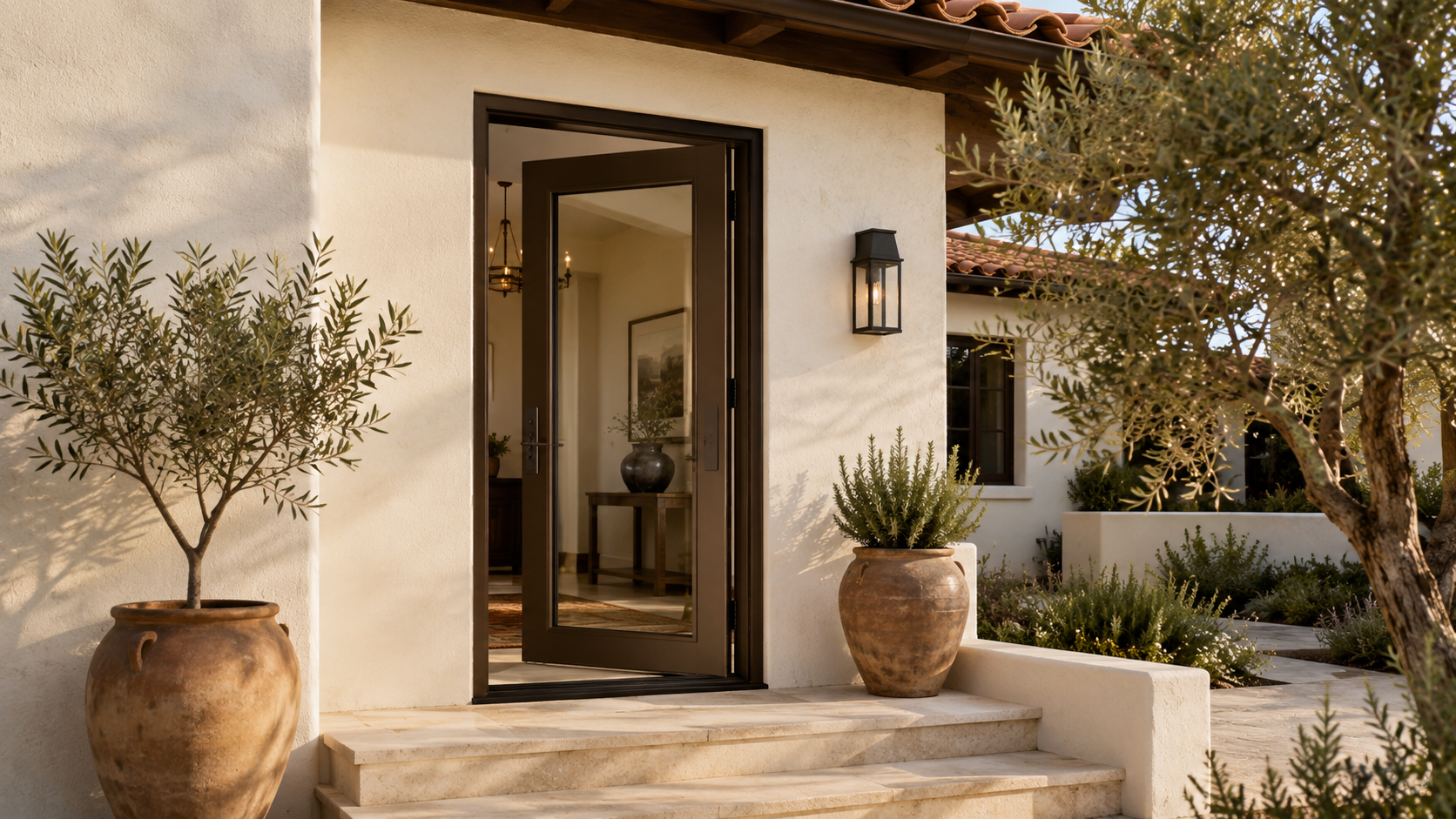
A full lite door is a door with a large glazed area covering most of the door slab. In door terminology, a "lite" is a piece or section of glass set into a door. A full lite design therefore provides substantially more glass than a half-lite or three-quarter-lite door, although the exact glass dimensions vary by manufacturer and door system.
The term is used most often for exterior entry and patio doors, but full lite designs are also available for interior doors. You may also see the spelling "full light door." Both phrases usually describe the same general design.
Full Lite vs. Half Lite and Three-Quarter Lite
The name describes how much of the door is visually occupied by glass, not necessarily the number of separate panes. For example, a door may have one large full-height glazed area or simulated divided lites created with grids.
| Door style |
Typical glass area |
Best suited to |
Main trade-off |
| Quarter lite |
Small upper glass section |
Added daylight with greater privacy |
Limited view and daylight |
| Half lite |
About the upper half |
Balanced privacy and light |
Less open than a full lite door |
| Three-quarter lite |
Most of the upper slab |
More daylight with some solid lower area |
Still exposes a large glazed surface |
| Full lite |
Most of the door slab |
Maximum daylight and views |
Privacy, solar gain, and cleaning need more attention |
Benefits of a Full Lite Door
More natural light. A large glazed area can brighten an entry hall, kitchen, home office, or transition space that would otherwise depend on artificial lighting.
A stronger indoor-outdoor connection. Clear glass creates a wider view of a patio, courtyard, garden, or private approach.
A clean architectural appearance. Full lite doors work particularly well with modern and transitional exteriors, but grids and decorative glass can also suit traditional homes.
Flexible privacy control. Frosted, reeded, tinted, laminated, decorative, or integrated-blind glass can reduce direct views without eliminating daylight.
Possible Drawbacks
Privacy can change after dark. During the day, exterior brightness may reduce views into the home. At night, an illuminated interior is easier to see through clear glass.
Thermal performance varies. A large glass area is not automatically inefficient, but performance depends on the complete door, glass package, frame, seals, threshold, and installation.
Security requires a system approach. Glass type matters, but the frame, lock, hinges, installation, and the relationship between the glass and lock area are also important.
More glass means more visible marks. Clear full-height glass generally needs more frequent cleaning than a mostly solid door.
Exterior, Interior, and Full-View Doors
An exterior full lite door must manage rain, air leakage, temperature differences, repeated operation, and locking. It may use an insulated glass unit, weatherstripping, a threshold, and safety glazing appropriate to its location.
An interior full lite door usually does not need exterior weather ratings. Its main purposes are to share daylight, maintain visual connection, or separate rooms without making them feel enclosed.
A full-view door is not always the same product. In the United States, "full-view" frequently describes a storm door installed in front of the primary entry door. Confirm whether a listing is for a complete entry door, a storm door, or only a replacement glass insert before comparing prices.
How Door Material Changes the Decision
The amount of glass does not determine the door material. Full lite doors can be built with fiberglass, steel, wood, aluminum, or other engineered systems.
Fiberglass is commonly chosen for low maintenance and dimensional stability. Available surfaces range from smooth finishes to molded wood-grain textures.
Steel can provide a slim, familiar entry-door construction and competitive pricing, but finish quality and corrosion protection are important in wet or coastal locations.
Wood offers natural grain and extensive finishing options. It generally requires more attention to finish maintenance and moisture exposure.
Aluminum supports narrow sightlines and contemporary designs. For exterior use, frame thermal breaks, glass-edge details, drainage, and climate suitability deserve careful review.
Do not select a full lite door by material alone. Compare the tested or documented performance of the complete configuration you intend to buy.
Choosing the Right Glass
Clear Glass
Clear glass provides the strongest view and the highest level of visual connection. It works best where the entrance faces a private garden, enclosed courtyard, or setback that limits direct views from the street.
Privacy and Decorative Glass
Frosted, etched, reeded, rain, patterned, and decorative glass diffuse views in different ways. Ask to see a full-size sample in both daylight and nighttime lighting because a small sample may not show the real privacy level.
Low-E and Insulating Glass
Low-emissivity coatings and insulating glass units can help manage heat transfer and solar heat gain. Their benefit depends on the coating, pane spacing, gas fill, frame, glass area, climate, and door orientation. "Low-E" by itself is not a complete energy-performance rating.
Tempered and Laminated Glass
Tempered glass is heat-treated so that it breaks into relatively small pieces. Laminated glass uses an interlayer that helps hold broken fragments together. Both can be used as safety glazing, but they behave differently and should be selected according to the project, code, and tested door design.
Is a Full Lite Door Energy Efficient?
It can be, but the answer must come from the whole-door rating. The National Fenestration Rating Council explains that U-Factor measures heat transfer through a product; lower values indicate better resistance to heat flow. Solar Heat Gain Coefficient, or SHGC, describes how much solar heat enters through the product. Lower SHGC values reduce solar heat gain, while higher values admit more of it.
Visible Transmittance, or VT, indicates how much visible light passes through. A very low SHGC and a high VT may be useful where daylight is wanted without excessive solar gain, but the best combination depends on climate, orientation, shading, and design priorities.
ENERGY STAR criteria for doors vary by glazing level, and qualifying values must be based on NFRC-certified ratings. Do not compare a glass-only U-value with a whole-door U-Factor or assume that every Low-E door qualifies for ENERGY STAR.
Safety and Security Considerations
In the United States, glazing used in doors falls within the scope of the federal 16 CFR Part 1201 safety standard for architectural glazing materials. Confirm that the selected glass and complete product meet applicable federal, state, and local requirements.
Safety glazing and burglary resistance are not the same thing. When security is a priority, evaluate laminated glass options, the frame-to-glass connection, lock type, hinge construction, strike reinforcement, sidelite placement, and professional installation. Hurricane or impact claims should be supported by approvals or reports for the exact product configuration and size.
Where Full Lite Doors Work Best
Private front entrances. Best where daylight and curb appeal are priorities and direct street views are controlled.
Patio and garden access. Clear glass can strengthen the visual connection to a courtyard or landscaped outdoor area.
Kitchens and side entrances. A full lite door can bring daylight into practical transition spaces.
Home offices and interior rooms. Glass preserves visual separation without creating a fully solid barrier.
Hospitality and office entrances. The selected system must still meet the project's commercial-use requirements.
How to Choose a Full Lite Door
Define the door's role. Confirm whether it is a primary exterior door, patio door, interior door, storm door, or replacement glass project.
Study privacy at night. Consider sightlines from the street and neighboring properties after interior lights are turned on.
Match glass to climate and orientation. A west-facing door in a hot climate may need different solar-control glass from a shaded north-facing entrance in a cold climate.
Measure the complete opening. Distinguish among nominal slab size, actual slab size, unit size, jamb depth, and rough opening. Common retail sizes include 32 x 80 and 36 x 80 inches, but the required rough opening depends on the specific prehung unit.
Confirm handing and swing. State the viewing position used to define left or right handing, and verify whether the door swings inward or outward.
Request configuration-specific documentation. Ask for the drawing, glass build-up, finish, hardware, threshold, warranty, and relevant energy, air-water-structural, safety, or impact documents before approving an order.
Frequently Asked Questions
Does full lite mean one pane of glass?
Not necessarily. "Full lite" usually describes the overall glazed proportion of the door. The glass may appear as one uninterrupted pane or be divided visually with grids or separate sections.
Are full lite doors safe for front entrances?
They can be appropriate when the glass, frame, hardware, locking system, and installation meet the project requirements. Safety glazing does not by itself establish forced-entry or impact performance.
Can a full lite door provide privacy?
Yes. Frosted, reeded, patterned, tinted, decorative, laminated, integrated-blind, and switchable-glass products offer different privacy levels.
Is a full lite door colder than a solid door?
It may transfer more heat than a highly insulated opaque door, but actual performance varies widely. Compare the whole-door U-Factor for the exact glass and frame configuration.
Should I buy a slab or a prehung unit?
A slab may suit an existing frame that is square, compatible, and in good condition. A prehung unit includes the door and frame as a coordinated assembly and is often easier to specify for new construction or a complete replacement.
Final Takeaway
A full lite door is a strong choice when daylight, views, and a visually open entrance matter. The best option is not simply the door with the largest piece of glass. It is the complete system that balances privacy, climate, energy performance, safety, security, maintenance, and architectural style.
Planning a custom full lite door?
Send the opening dimensions, preferred glass, handing, quantity, and project location to request a configuration review and quotation.
REQUEST A FULL LITE DOOR QUOTE
Sources