Wood Interior Doors Style Construction and Buying Guide
A practical guide to choosing wood interior doors, from construction and finish to slabs, prehung units, hardware, and bedroom-opening details.
A practical guide to choosing wood interior doors, from construction and finish to slabs, prehung units, hardware, and bedroom-opening details.
Product education article
Product page: https://www.georgewindowdoor.com/doors/bedroom-doors
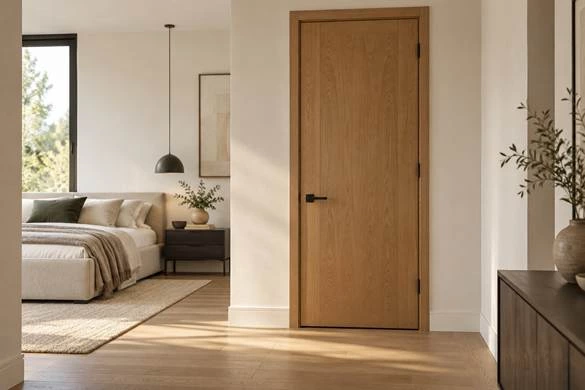
Wood interior doors do more than divide rooms. They shape sightlines, influence privacy, and provide a tactile material contrast to painted walls and flooring. The best choice starts with the room, the opening, and the visual language of the home—not just a finish swatch.
This guide explains the decisions worth settling before you request a quote for wood interior doors, especially bedroom doors.
For a bedroom, list the job the door needs to do. Is it primarily a visual upgrade? Is privacy important? Does the opening need to accommodate a particular swing direction, accessible clearance, or a compact room layout? These answers guide the construction, configuration, and hardware conversation.
The public landing page linked for this project was not accessible during research. For that reason, this article does not make unverified claims about George Window & Door products, finishes, dimensions, ratings, or availability.
“Wood interior door” can describe several constructions. A door may be solid wood, solid core with a wood veneer or paint-grade surface, or another engineered construction. Each option should be compared from its actual specification sheet rather than its appearance alone.
The practical question for a quote is simple: what is the core, what is the face material, and what performance is specified for this opening? Manufacturer guidance commonly separates interior doors by construction, including hollow-core and solid-core options, so it is worth asking the supplier to identify the construction in writing.
| Question to ask | Why it matters |
| Is the door solid wood, solid core, or hollow core? | Construction affects the product you are actually comparing. |
| Is the surface a veneer, a wood face, or paint grade? | This sets realistic expectations for grain and finishing. |
| What are the leaf thickness and frame details? | The door, jamb, hinges, and opening must work as a system. |
| Is any acoustic, fire, or privacy performance required? | These requirements should be specified for the exact assembly. |
Flat-panel doors emphasise clean grain and quiet geometry. Shaker-style or rail-and-stile doors add shadow lines and work well where the architecture has more detail. A narrow glass insert can bring borrowed light into a hall, but bedroom privacy should be considered before selecting glass.
When choosing a stain, compare a physical sample beside the floor, skirting, wall paint, and major furniture. Wood tone can shift substantially under warm and cool light. For a cohesive result, decide whether the door should blend with the floor, echo a furniture finish, or deliberately contrast with both.
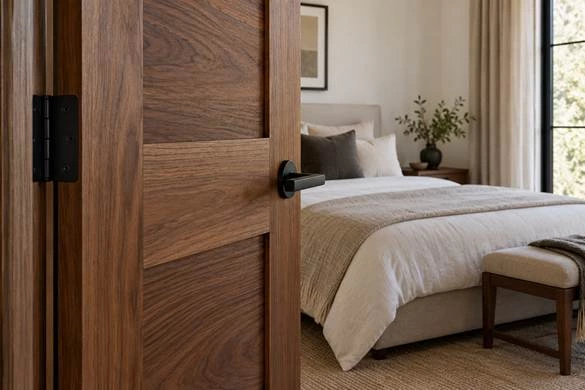
A slab is the door leaf only. A prehung door is supplied as a door mounted in a frame. The right route depends on the condition of the existing frame, the precision of the opening, and the installation plan. If an existing jamb will remain, confirm its condition, dimensions, hinge locations, and latch position before ordering a slab. If the opening is new or the frame is being replaced, a coordinated door-and-frame package can simplify specification.
Also confirm handing: stand on the side from which the door opens toward you and record the hinge side and swing direction using the supplier’s convention. A marked floor plan and photos of the opening help avoid ambiguity.
Bring these details to a supplier or installer before asking for pricing:
Avoid assuming that a beautiful door photo confirms any of these details. Request the product drawing, installation guidance, and written scope for the selected configuration.
Once you have the opening information and style direction, use the bedroom door page to begin a focused conversation about your project: explore bedroom door options at George Window & Door.
Include photos of both sides of the opening, approximate dimensions, the desired door style, and whether you are replacing an existing door or specifying for new construction. That gives the supplier a stronger starting point than a keyword alone.
They can be, provided the chosen construction, fit, hardware, and any required privacy or acoustic performance match the room. Confirm these characteristics against the exact product and installation details rather than relying only on the visible wood finish.
Compare the actual core and face materials, edge construction, finish options, thickness, weight, frame compatibility, warranty, and any relevant performance documentation. Ask for samples and drawings so the comparison is based on the specified product.
Choose based on the condition and accuracy of the current jamb, the scope of renovation, and who will install it. A slab must align with existing hinge and latch locations; a prehung unit includes a matched frame but needs the opening prepared accordingly.
Whether you have detailed drawings or just an early idea, our team will help you plan windows, doors, and the complete building materials for your project.

Send us your product requirements, project information, drawings or reference images — we usually reply within one business day.
We use cookies to collect information about how you use this site. We use this information to make the website work as well as possible and improve our services.more details