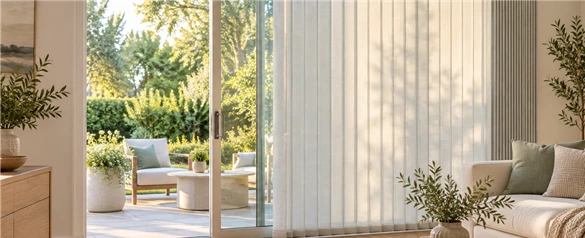
Choose the operating pattern before the fabric, color, or finish
The wrong blind can turn a sliding door into an obstacle course. It catches on the handle, blocks the opening, or gets left half-open because moving it is more trouble than living with the glare. The best blinds for sliding glass doors are not chosen from a fabric sample first. They are chosen by watching how the door moves and how people move through it.
This guide is for homeowners planning a patio-door update, as well as builders and designers who want the covering and the door to work as one system.
The 30-second answer
Choose a treatment that travels in the same direction as the door. For a frequently used sliding glass door, side-to-side systems such as vertical blinds, panel-track blinds, and vertical cellular shades usually create less daily friction than a single large shade that must be raised before anyone can pass. Drapery can work well when there is enough wall space for the fabric stack. Integrated blinds may be worth discussing when the door itself is being replaced.
Before choosing a product, verify five things: the active panel, handle clearance, stack location, privacy after dark, and the amount of glass you want exposed when the covering is open.
In this guide
- Watch the door before shopping
- Use the stack test
- Match the treatment to the room
- Rehearse the installation with masking tape
- Know when the door itself belongs in the conversation
Watch the door for one ordinary day
Start with behavior, not catalogues. Notice which panel slides, which hand reaches for the handle, and whether people use the door with full hands. Observe the light at breakfast, late afternoon, and after dark. A covering that works beautifully at noon may not provide the privacy expected when the room is illuminated at night.
Then ask a blunt question: Will the blind need to move every time the door is used? If the answer is yes, ease of operation matters more than a small difference in fabric or vane style. Hunter Douglas and Pella both present sliding-door treatments as a balance of access, light control, privacy, and room design rather than a one-feature decision.
The stack test changes the shortlist
Every traversing blind occupies space when open. That folded fabric, group of vanes, or set of overlapping panels is the stack. If it sits in front of the active opening, the nominal width of the doorway and the usable walking width will not be the same.
Look at the wall on both sides of the glass. A one-way stack may suit a door whose active panel is always on the same side. A split stack may frame the view more evenly, but it can place material near both edges. The right answer depends on the actual opening and the supplier's product dimensions.
| What happens at your door? |
A sensible starting point |
What to verify |
| People pass through it many times a day |
Vertical blinds, panel track, or vertical cellular shades |
Stack clears the active panel and handle |
| The view matters most during the day |
A treatment that stacks compactly beyond the glass where possible |
Open-stack width and available wall space |
| Night privacy is the priority |
Opaque vanes, room-darkening fabric, or layered coverage |
Privacy under interior lighting, not only in daylight |
| The opening has little side wall |
A compact-stack option or a door-integrated solution |
Headrail depth, jamb space, and service access |
Three rooms, three different answers
The busy kitchen door
This door opens for pets, groceries, and outdoor meals. A treatment that can be moved laterally with one simple action is usually easier to live with than a full-width blind that must travel vertically. Vertical blinds remain relevant here because their vanes can rotate for light control and traverse to the side for access. The real test is whether the stack stays away from the handle and the route outside.
The west-facing living room
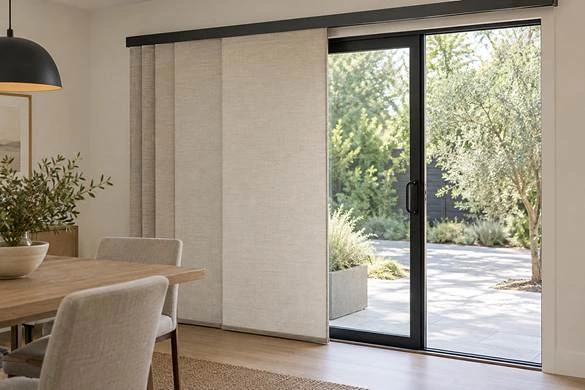
The view is valuable until low afternoon sun reaches the seating area. Panel-track blinds can turn a large expanse of glass into a calm architectural surface, while broad panels move on an overhead track. They are visually quieter than many narrow vanes, but the overlapping panels create a defined stack. Plan where that stack will live before falling in love with the fabric.
The bedroom patio door
Here, nighttime privacy and room darkening may outrank the daytime view. Vertical cellular shades are available in light-filtering and room-darkening configurations, according to manufacturer and retailer product guides. Drapery may add softness and layered coverage, provided the rod or track, return, stack, and floor clearance are properly planned. Do not assume a sheer or solar material will deliver the same privacy at night that it appears to provide during the day.
A plain-English comparison of the main options
Vertical blinds offer vane rotation and side-to-side travel. They can suit high-traffic openings, but vane durability, bottom details, operating hardware, and replacement parts deserve attention.
Panel-track blinds use broad fabric panels. They create a modern, ordered look and can cover wide glass, though the panels overlap and need stack space.
Vertical cellular shades fold laterally in an accordion-like stack. They are worth considering when the goal includes a softer appearance or a choice between light-filtering and room-darkening fabrics. Confirm the exact stack, track, and operating configuration.
Roller shades keep the visual language simple, particularly when separate shades are aligned with individual glass sections. On a frequently used doorway, however, a lowered shade can become another step before access. Check whether the proposed layout allows the active panel to operate independently.
Drapery brings texture and can layer sheer daytime control with more opaque nighttime coverage. It also needs wall or ceiling support, floor clearance, and enough room for the fabric to park without narrowing the passage.
Try the masking-tape rehearsal
You can expose a poor layout before paying for it.
- Mark the proposed headrail or track on the wall with painter's tape.
- Mark the supplier's stated stack width at the side where the treatment will park.
- Open the active door to the position used most often.
- Trace the handle projection and check for contact with the proposed blind path.
- Carry a laundry basket or shopping bag through the remaining opening.
- Sit in the room after dark with the lights on and define the privacy level you actually expect.
Take front-on and angled photos with the tape still in place. These images, together with opening measurements and the door's operating direction, give a supplier useful information for a more specific recommendation.
Sometimes the conversation is really about the door
If the current sliding door is difficult to operate, has damaged hardware, or no longer suits the opening, choosing a blind is only part of the project. Replacement planning can consider the door configuration, glass, frame, hardware, threshold, and covering strategy together.
To start that conversation, visit the George Window & Door sliding glass doors page. Share photographs, approximate opening dimensions, the active-panel direction, and what you want to change about light, privacy, access, or the door itself. Product availability and specifications should be confirmed directly for the project.
Quick questions people ask before ordering
Are vertical blinds outdated for sliding glass doors?
Not functionally. Their side-to-side movement and rotating vanes still solve the access and light-control problem well. Whether they look dated depends on the material, vane width, hardware, color, and surrounding room. Compare them with panel-track and vertical cellular systems using the same opening and stack requirements.
Can I use roller blinds on a sliding glass door?
Yes, but the layout matters. A single lowered shade can block access, while separate shades may allow the active panel to operate more independently. Confirm maximum product dimensions, control locations, handle clearance, mounting depth, and whether each shade can be operated safely and conveniently.
Should blinds stack on the fixed-panel side?
Often that is a logical starting point because it may keep the active opening clearer, but it is not a universal rule. Door direction, available wall space, handle location, furniture, and the blind's actual stack width all affect the choice. Rehearse both positions before ordering.
Make movement the final filter
The best blinds for sliding glass doors feel almost uneventful in daily use. They move where the door moves, park where people do not walk, and provide the level of light control and privacy expected at the relevant time of day. Choose the operating plan first; then select the material and color that make it belong in the room.