Blinds for Sliding Glass Doors
Compare seven practical blinds and shades for sliding glass doors, then use a five-point fit check to protect access, privacy, glare control, and everyday comfort.
Compare seven practical blinds and shades for sliding glass doors, then use a five-point fit check to protect access, privacy, glare control, and everyday comfort.
SEO title: Blinds for Sliding Glass Doors: 7 Options | GEORGE
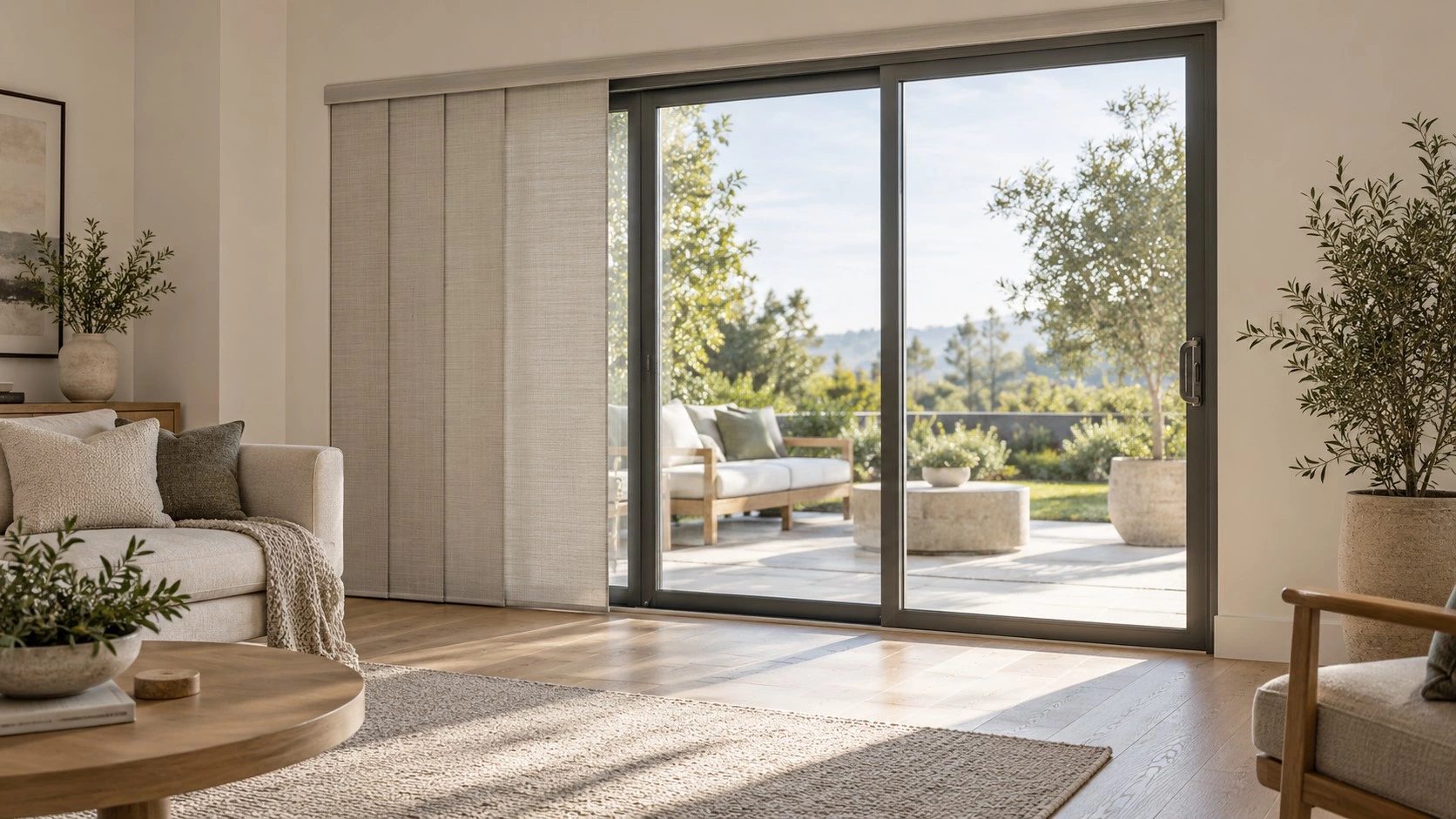
The best blinds for sliding glass doors move with the door instead of fighting it. For a doorway used several times a day, start with a side-opening treatment such as vertical blinds, panel-track blinds, or vertical cellular shades that can park beyond the active panel. Choose roller or solar shades when glare matters more than walk-through access, and consider drapery or vertical sheers when softness and room-darkening are the priority.
The deciding factor is not simply style. It is whether the treatment clears the handle, leaves the walking path open, and has somewhere to stack when the door is in use. This guide compares seven practical options and gives you a five-point fit check to complete before requesting a quote.
Use the door the way you normally do, then match your biggest constraint to the shortlist below:
Before deciding, fully open the door and mark the area occupied by the moving panel, handle, screen, and blind stack. If those elements collide on paper, they will be more frustrating after installation.
No single treatment wins every category. The table below compares the practical trade-offs that matter most on a moving doorway.
| Option | Best for | Access when open | Main advantage | Main limitation |
| Vertical blinds | Busy doors and controlled budgets | Good if vanes stack beyond the active panel | Simple side-opening operation; individual vanes may be replaceable | Vanes can swing, twist, or look visually busy |
| Panel-track blinds | Wide doors and modern rooms | Excellent with enough side parking space | Broad panels create a clean, architectural look | The parked stack is wider than many buyers expect |
| Vertical cellular shades | Comfort and a compact stack | Good when sized for the opening | Honeycomb construction adds an insulating layer | Large custom units need careful sizing and service support |
| Roller or solar shades | Glare control and preserving a daytime view | Fair; the active shade usually must be raised | Compact overhead profile and many fabric choices | Daytime view-through fabric may not provide privacy at night |
| Vertical sheer shades | Soft light and a furnished appearance | Good if the full bundle clears the passage | Combines vertical movement with light diffusion | Fabric needs gentler cleaning and may not darken the room fully |
| Drapery | Bedrooms and layered room design | Excellent with adequate wall stack | Strong decorative range and good darkening potential | Requires wall space, sturdy hardware, and floor clearance |
| Between-the-glass blinds | New doors and replacement projects | Excellent; no room-side stack | Protected from ordinary room dust and traffic | Usually not a retrofit for an existing door |
Vertical blinds remain useful because their motion matches a sliding door. They can open from one side, clear a large span, and keep the controls simple. They are most convincing in a high-traffic room where easy operation matters more than a seamless fabric surface. Check vane stability, control type, and the width of the parked bundle; a stack that covers the handle defeats the reason for choosing them.
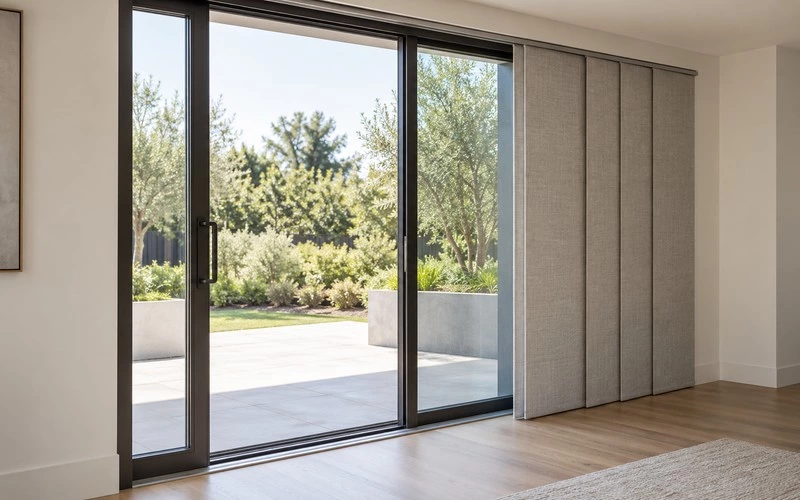
Panel tracks use broad fabric panels on an overhead rail. They suit large contemporary openings and can coordinate with solar or room-darkening fabrics. Their strength is also their constraint: wide panels need a clear parking zone. Ask for the finished stack width, not only the overall product width, and decide whether the stack will sit over the fixed panel or extend onto the adjacent wall.
Vertical cellular shades move sideways while adding a honeycomb layer between the room and the glass. They are worth comparing for a frequently used door in a room that feels hot or cold near the glazing. Confirm the maximum finished size, stack width, replacement-part policy, and how the fabric is cleaned; the category name alone does not guarantee performance for every door assembly.
Roller and solar shades work well when each glass panel can be covered separately. A shade on the fixed panel can reduce glare while leaving the doorway usable. On the active panel, however, the shade normally needs to be raised before someone walks through. Solar fabrics can preserve a daytime view, but privacy reverses after dark when the room is brighter than the patio. Test a sample under evening conditions.
Vertical sheers soften a large wall of glass without the hard lines of vinyl vanes. Their rotating vanes can adjust light and privacy while the treatment traverses to the side. They suit formal living and dining spaces, but households with pets, sticky hands, or heavy traffic should compare fabric care and bottom stability before choosing appearance over durability.
Drapery is not a blind, but it solves many of the same problems. Lined panels can improve nighttime privacy and room darkening, while ceiling-height installation can make a wide opening feel intentional. The trade-off is physical space: the fabric stack, rod or track, hem, and threshold must all stay clear of the moving door.
Integrated blinds sit inside a compatible glass or door system, so they do not swing into the passage or collect ordinary room dust. They make the most sense when the door is already being specified or replaced. Treat them as a door-system decision: confirm available sizes, control method, glazing configuration, service access, and warranty before assuming they can be added later.
A sliding door is a passage, window, handle, screen, and track in one assembly. The covering must work around all five. That is why a beautiful shade can still be the wrong purchase.
Stand inside the room and identify which panel moves and which side it moves toward. Open it completely. The blind should park on the fixed-panel side or beyond the active opening whenever possible. Measure the clear passage after the treatment is stacked, not just the glass width, because the parked material can narrow a doorway that looked generous on the order sheet.
Measure the handle at its furthest projection and include the lock, trim, screen frame, and any molding. At the top, verify that the track or cassette has a continuous mounting surface. At the bottom, allow for the raised threshold and normal floor movement. A low rail or long fabric panel that brushes the sill will quickly become dirty or difficult to operate.
"Light filtering" and "private" are not interchangeable. During the day, exterior brightness can obscure the view inward. At night, interior lighting can reveal silhouettes or more through the same fabric. For a bedroom or street-facing room, view a sample from outside after dark before approving color and openness.
For a family room with constant patio access, start with vertical or panel-track blinds and put durability, simple controls, and a clear passage ahead of decorative detail. A wand or cordless control can help keep loose controls out of the walking route; ask the supplier which options meet current safety requirements for the exact product.
For a west-facing living room, solar shades can control screen glare while maintaining a daytime connection to the outdoors. Separate shades for separate panels give more flexibility than one very wide shade, provided the cassettes and bottom rails clear the handle and each other.
For a bedroom, nighttime privacy should be tested before light softness. Room-darkening vertical cellular shades or lined drapery are stronger starting points than open solar fabric. Expect some edge light unless the system includes side channels or overlapping layers designed for darkening.
For a minimalist room, panel tracks create the cleanest broad surface when there is enough side space. If there is no parking zone, a sleek product can become a bulky obstruction. In that case, separate rollers or a door configuration with integrated shading may be more practical.
Send the supplier the photos, these measurements, the operating direction, and your top priority. The final quote should repeat the finished width and height, stack side, control side, mounting method, material, and installation responsibility. If any of those fields are missing, clarify them before approving the order.
Blinds cannot correct a door that drags, leaks, has a loose handle, or opens on the wrong side for the room. Test the bare door before adding a heavy covering. If the panel does not glide smoothly or the hardware already collides with the screen, repair or assess the door first.
When the project already involves replacement, coordinate the covering with the frame depth, active-panel direction, handle profile, glazing, and wall space. GEORGE’s custom sliding glass door configurations can help you evaluate those door-level choices before you reserve space for a blind. It is a door-planning resource, not a claim that every blind type above is sold with the door.
For a busy doorway, a side-opening vertical blind or panel-track system is usually the most practical starting point because it can follow the door’s movement. The best final choice depends on stack space, handle clearance, privacy, glare, and how often people use the passage.
Not functionally. Vertical blinds still suit wide, frequently used doors and can be economical to maintain. Panel tracks or vertical sheers offer a more contemporary appearance, but they may require more stack space or gentler care.
Yes, especially as separate shades over the fixed and moving panels. They work best when the active shade can be raised before passage and when the cassette, bottom rail, and fabric clear the handle and screen.
Light-filtering cellular shades and vertical sheers can soften daylight, while solar shades may preserve more view. None should be assumed private at night. Test the selected fabric from outside with the room lights on.
The answer depends on frame depth, trim, handles, and the product’s hardware. Many sliding-door treatments use an outside or overhead mount because the opening lacks enough recess depth. Follow the manufacturer’s measuring instructions for the exact system rather than applying a generic window rule.
Choose the treatment in this order: protect the walking path, clear the hardware, reserve a parking zone, then optimize privacy, glare, comfort, and style. Vertical blinds are the practical baseline; panel tracks are the cleanest choice for wide modern openings; cellular shades add a comfort-focused option; rollers and solar fabrics excel at glare control; sheers and drapery prioritize softness; integrated blinds belong in a door-replacement conversation.
Do the five-point check before comparing colors. A measured photo and a clearly stated priority will produce a better quote and are far more likely to prevent an expensive fit problem than ordering from glass width alone.
Whether you have detailed drawings or just an early idea, our team will help you plan windows, doors, and the complete building materials for your project.

Send us your product requirements, project information, drawings or reference images — we usually reply within one business day.
We use cookies to collect information about how you use this site. We use this information to make the website work as well as possible and improve our services.more details